

- 53+ Reviews on Google
- Multilingual Team
- Registered NDIS Provider #4050126032
NDIS Household Tasks Support in Melbourne
Managing cleaning, laundry, meals, or other household tasks can become difficult when your disability affects what you can safely do on your own. Hilda Care provides NDIS household tasks support across Melbourne, including Preston, Werribee and Tarneit, to help participants maintain a safe and comfortable home.


What We Help With
Our team assists with:
- General cleaning
- Laundry and linen changes
- Meal preparation
- Grocery assistance
- Household organisation
- Rubbish removal and basic pathway maintenance
All tasks are agreed upon before support begins. Worker time is what the NDIS funds; things like cleaning products, groceries, and ingredients are the participant’s own costs.
What Is NDIS Household Tasks Support?
Household tasks support is funded under the Core Supports budget, within the Assistance with Daily Life category. It is available to participants whose disability affects their ability to safely manage home tasks on their own.
Funding covers worker time only. Grocery costs, cleaning products, and other consumables are not included. What is covered in a participant’s plan depends on their individual circumstances and what the NDIA has approved.

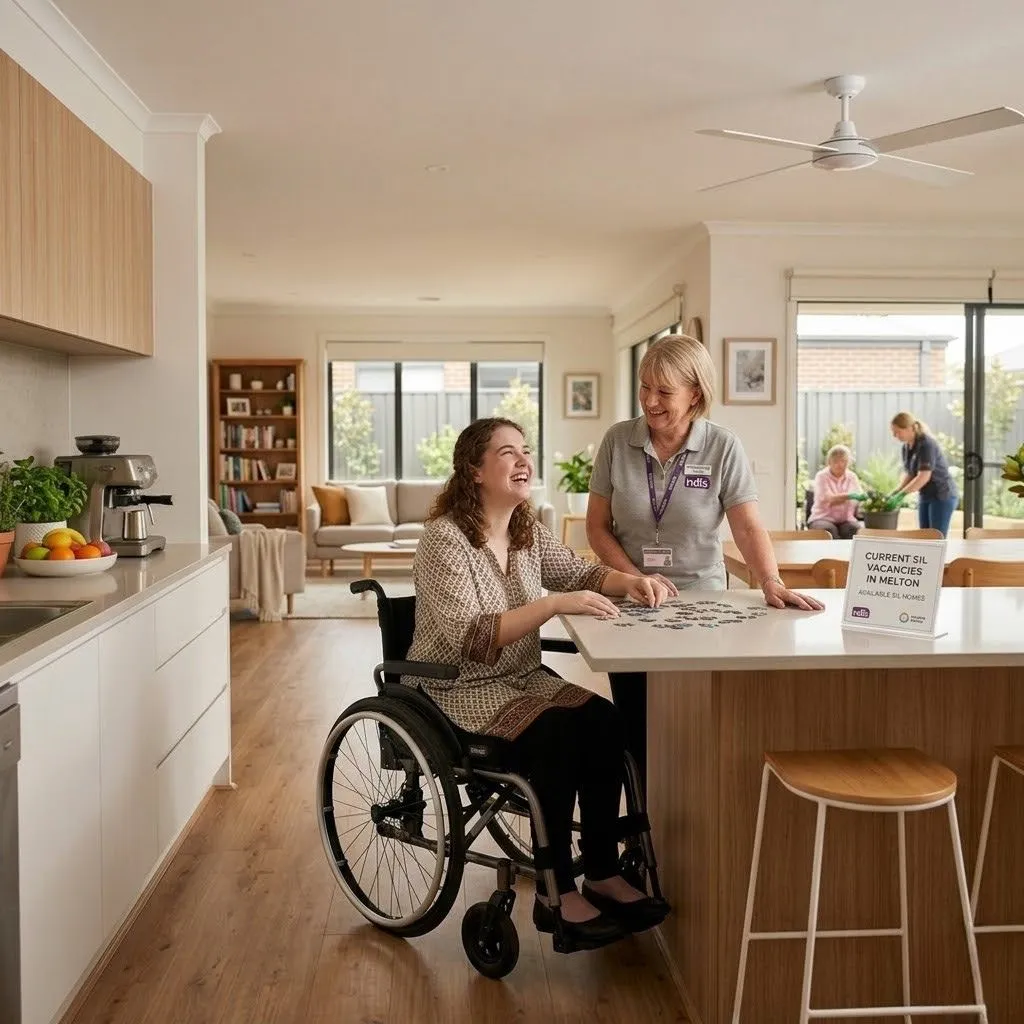
What Hilda Care Assists With Under NDIS Household Tasks
Tasks our team commonly provides include:
- General cleaning: vacuuming, mopping floors, wiping surfaces, and cleaning bathrooms and kitchens
- Laundry: washing, drying, folding clothes, and changing bed linen
- Meal preparation: preparing meals to suit dietary requirements, health conditions, and cultural preferences
- Grocery assistance: accompanying participants to the supermarket or collecting items on their behalf
- Bed linen changes: stripping and remaking beds on a regular schedule
- Rubbish removal: emptying bins and removing waste from accessible areas of the home
- Basic pathway maintenance: clearing overgrowth or debris where a safety risk exists
- Window and surface cleaning: cleaning windows, mirrors, and hard-to-reach surfaces where reaching or lifting is a barrier
- Ironing and clothes care: ironing and folding garments, where this cannot be safely managed independently
Each task needs to be linked to the participant’s disability and approved as part of their plan. Tasks are confirmed before support begins.
Why Melbourne Participants Choose Hilda Care
Registered with the NDIS Quality and Safeguards Commission
Hilda Care has been registered with the NDIS Quality and Safeguards Commission for years, under Provider Registration Number 4050126032. Registration means service delivery is audited against the NDIS Practice Standards.
NDIS-Screened and Police-Checked Team
Our team holds current NDIS Worker Screening clearances and police checks and is trained in trauma-informed care. Where possible, the same worker is assigned to each visit so they are familiar with the participant’s home and preferences.
Multilingual Support Staff
Our team includes staff who speak English, Italian, Turkish, Filipino, Portuguese, and Macedonian. Participants can communicate preferences and instructions in their preferred language, supporting the accurate delivery of agreed-upon tasks.

Who Qualifies for NDIS Household Tasks Funding
Eligibility is based on how a participant’s disability affects their ability to complete home tasks, not on diagnosis alone. Evidence such as assessments, reports, or information about how your disability affects daily activities may be considered during planning.
How your plan type affects your provider choice:
NDIA-managed:
must use a registered NDIS provider such as Hilda Care
Plan-managed:
can choose any provider; a plan manager handles payments on your behalf
Self-managed:
the participant manages their own payments and can use any provider they choose
If household tasks are not included in your current plan, you can request a review through the myNDIS portal. Our team can help you understand what information may be needed to support that request.
Our Approach to the Household Support Process in Melbourne
Check Your Plan
Confirm that household tasks funding is included under Assistance with Daily Life in your current NDIS plan.
Initial Contact
Contact our team to discuss your support requirements and confirm availability in your area.
Service Agreement
A service agreement is prepared, setting out which tasks are included, how often, and the applicable rates, reviewed and signed before support begins.
Meet Your Support Worker
Your allocated support worker is introduced before the first session, with time to walk through your home and agreed task list.
Support Begins
Scheduled support commences according to the agreed roster, with tasks carried out as confirmed in the service agreement.
What the NDIS Does and Does Not Fund for Household Tasks
A common source of confusion is what the NDIS actually pays for. The table below sets this out.
| Service / Item | NDIS Funded | Participant Cost |
|---|---|---|
| Support worker time for cleaning | ✓ | |
| Cleaning products and equipment | ✓ | |
| Support worker time for grocery shopping | ✓ | |
| Grocery costs | ✓ | |
| Support worker time for meal preparation | ✓ | |
| Food and ingredients | ✓ | |
| Basic path maintenance (safety-related) | ✓ | |
| Landscaping, tree trimming, structural work | ✓ | |
| Laundry support (worker time) | ✓ | |
| Laundry detergent and consumables | ✓ |
If you are unsure what your current plan covers, our team can review it with you before you sign a service agreement.
Combining Household Tasks with Other NDIS Supports
Household tasks support can run alongside other supports in a participant’s plan. Many participants also receive personal care, community participation, or life skills development through their Core Supports budget.
These can be coordinated under the same service agreement that suits the participant’s routine.
If a participant’s goals include building skills over time, for example, learning to manage kitchen tasks more independently, that type of goal-directed support is funded through the Capacity Building budget, typically via an occupational therapist. Our team can work alongside a participant’s support coordinator or plan manager to make sure the right budget is being used.


Household Support Across Melbourne
Participants across Melbourne’s northern, eastern, western, and southern suburbs can receive assistance with daily household activities, including in areas such as Sunshine, Point Cook, Broadmeadows, Glen Waverley, and Frankston.
Our team works with participants across different living arrangements, including shared housing, private rental, and supported accommodation.
Household tasks support in Preston is run by our NDIS provider Preston team.
Frequently Asked Questions
What are household tasks under the NDIS?
Household tasks are NDIS Core Supports that cover help around the home — cleaning, laundry, meal preparation and grocery shopping — where your disability makes it hard to do them yourself.
How many hours can I get for household tasks?
It depends on your plan and what the NDIA has approved based on your individual situation. Some participants get a few hours a week; others get more.
Can I shift my Core Supports budget to get more hours for household tasks?
Generally yes. Core Supports is flexible within the budget category, which means you can allocate more toward household tasks without a formal plan review, as long as you stay within your total approved amount and the shift aligns with your plan goals. If you are unsure how much flexibility you have, your plan manager or support coordinator can advise.
Does the NDIS cover dishwashing?
Yes, if your disability makes it difficult to do safely on your own. Dishwashing falls under general household cleaning within the Assistance with Daily Life category. The key is that it must be linked to your disability; it cannot simply be a general convenience.
Can someone be home with me during the support visit?
Yes. Family members, carers, or anyone you choose can be present. That is entirely up to you. Most participants prefer to be home for the first visit so they can walk the worker through their preferences.
What is the difference between household tasks and personal care?
Household tasks are about home cleaning, laundry, and meal prep. Personal care is about helping you with showering, dressing, and grooming. Both are funded under Core Supports, but as separate items. It depends on what is in your plan.
 Posted on Google
 Omar Soliman
Trustindex verifies that the original source of the review is Google.
Really happy with the support I’m getting. Everyone is friendly, easy to talk to, and actually listens. I feel supported and comfortable. Would definitely recommend.Posted on Google WarrenI have found the services to be unbelievably great in my situation. I recommend the services to everyone who wants to be taken care of in Melbourne.Posted on Google
 Amira MoussaI’m so grateful for the care and support I receive from Hilda Care. I’ve always felt respected, valued, and genuinely listened to. The team is kind, patient, and supportive, and communication is always clear! I honestly feel lucky to be part of a service that truly cares about their clients. Thank you!!!Posted on Google
 Omar Moussa (omzy96)Lovely NDIS provider providing support throughout all of Melbourne. I have personally recieved support through Hilda Care for the past 6 months roughly. Their administration is top notch. They have gone above and beyond providing personalised support workers for my needs, have promptly resolved any issues I may have and they always try their best to deliver extra services that may help me with my needs and support. Thank you Hilda Care, you've made my transition into the NDIS as seamless as possible, and I really look forward for the years ahead 😊Posted on Google
 Grahm WatsonThanks for looking after me in SIL house in Burnside Heights. Management is excellent. Happy is looking after me very well. ThanksPosted on Google
 Kim Fleming
Trustindex verifies that the original source of the review is Google.
My experience dealing with this organisation has been very disappointing. They seem unorganised, unprofessional arrogant and downright disrespectful of peoples time.Posted on Google Divyanshu SethiHilda Care is outstanding. As a Support Coordinator, I’ve had situations where I needed a Support Worker at the very last minute for my cleints, and they delivered without hesitation. Not once or twice but always. They found the right person within hours and made sure the client felt safe and supported. They have paid heed to client’s feedback and tweaked their services accordingly everytime. Their staff are well trained, reliable, and always go above and beyond to meet client needs. It’s clear they genuinely put clients first. Highly recommended.Posted on Google
 Tommy NjegacThank you Hilda care for providing me services in caroline springs. Harry is amazing support worker. He really understands me well and my needs. God bless your company.Posted on Google
 Yasemin YakupThis is one of the most reliable and compassionate disability service providers we’ve worked with. Their communication is clear. The support workers show great understanding and patience, especially during challenging moments. They make everyday routines more enjoyable and less stressful for everyone involved. We feel very lucky to have them on our side.Verified by TrustindexTrustindex verified badge is the Universal Symbol of Trust. Only the greatest companies can get the verified badge who has a review score above 4.5, based on customer reviews over the past 12 months. Read more
Start Your NDIS Household Tasks Support
Our team works with participants, support coordinators, and plan managers across Melbourne to set up household tasks support that fits each person’s plan and daily routine. If you have questions about eligibility, what tasks can be included, or how to get started, we can walk you through the process.
Household tasks can be part of a wider NDIS home care Melbourne roster.