

- 53+ Reviews on Google
- Multilingual Team
- Registered NDIS Provider #4050126032
Disability Service and Support Providers in Melbourne
Reliable disability support means more than just getting daily tasks done. It’s about having support workers who know your routine, communicate clearly, and show up on time, making life easier instead of adding stress.
Hilda Care offers disability support services across Melbourne. We help with personal care, household tasks, community participation, and supported independent living, all tailored to each person’s goals and NDIS plan.


What Our Disability Support Services Include
Disability support services cover the practical help people with disability need to live safely, manage their home, and stay connected to their community. What’s included depends on each person’s plan and goals.
Showering, dressing, and other daily personal routines, delivered with respect for privacy and independence.
Cleaning, laundry, and meal preparation, so the home stays safe and manageable.
Support to join social groups, pursue hobbies, and get out into the community.
Daily or overnight support at home for participants who need a higher level of assistance.
Ongoing support with everyday routines, including in shared living arrangements.
Structured support for participants building independence and new skills over time.
Not everyone needs every type of support. We build your support around your plan and goals, not a set package.

What to Look for in a Disability Support Provider
It can be hard to choose a disability support provider in Melbourne since many websites sound similar. Here are some practical things to check before signing a service agreement:
- Registration status. Ask whether the provider is registered with the NDIS Quality and Safeguards Commission, and check it directly on the Commission’s public register rather than taking it on faith. Hilda Care’s registration covers specific approved categories, including Assist-Personal Activities, Household Tasks, Community Participation, Development of Life Skills, and Supported Independent Living, all listed on the public register.
- Worker screening. Every worker should hold a current NDIS Worker Screening clearance and police check before entering someone’s home. This is checked before a worker is assigned to a participant, not after.
- Consistency. Ask how the provider manages things if your regular worker can’t make it, and whether you’ll usually see the same person or different staff each week. We try to match you with a worker who fits your personality, communication style, and language, and keep that match steady instead of changing staff every week.
- A single point of contact. Find out if you’ll talk to a call centre or someone who knows your situation. We assign each participant a dedicated coordinator who understands your plan, so you don’t have to explain everything to a new person each time.
- How complaints are handled. A provider who explains this clearly upfront, in writing, in the service agreement, is generally more reliable than one who gives vague reassurances.
We Offer Specialised Disability Support for Complex Needs
Some people need support that’s more than just daily care or help at home. This might be due to a specific diagnosis, complex needs, or a family member balancing caring with their own life. These situations often need workers with special training and experience.
Acquired Brain Injury Support
Support built around the functional impact of a brain injury, whether that’s memory, fatigue, emotional regulation, or physical mobility, rather than the diagnosis itself.
Psychosocial Disability Support
Practical, consistent support for participants living with the ongoing effects of a mental health condition, including daily routines and community access.
Carer Inclusive Care and Respite
Support that keeps family and carers informed and involved, alongside short-term accommodation and respite options when a carer needs a break.
Implementing Behaviour Support Plans
Trained workers who implement a formal behaviour support plan consistently, guided by the plan rather than improvising in the moment.


Who Can Access Disability Support Services
Eligibility is based on how your disability affects your ability to manage daily activities safely, not just your diagnosis. You can get disability support services from Hilda Care no matter how your plan is managed:
- NDIA-managed: The provider claims directly against your plan via the NDIS portal
- Plan-managed: Your plan manager pays provider invoices from your plan
- Self-managed: You pay the provider directly and claim the costs back from the NDIA
If you’re unsure what support your plan covers, or if a certain service is included, our team can help you figure it out.
Our Approach to Disability Support
| Step | What Happens |
|---|---|
| 1. A proper first conversation | Rather than a quick intake call, we talk through your goals, routine, and what hasn't worked well before, so we're not guessing at what you actually need. |
| 2. Checking your funding before anything is arranged | We confirm what's actually covered in your plan first. This avoids the common problem of support being arranged and then falling through once funding doesn't line up. |
| 3. Matching based on more than availability | We match you with a worker based on personality, communication style, and language where relevant, not just whoever happens to be free that week. |
| 4. A proper handover to your worker | Your worker is briefed on your routine and preferences before the first shift, so you're not left explaining everything from scratch on day one. |
| 5. Staying with the same worker | We aim to keep you with the same worker over time rather than rotating casual staff, and arrange proper cover if they're unavailable. |
| 6. Checking in, not just checking a box | We follow up regularly, not only at scheduled reviews, so changes in your needs or goals get picked up early rather than waiting for the next formal review. |
How Hilda Care Supports NDIS Participants in Everyday Life
For many people, the hardest part of support isn’t the tasks, but having to explain routines and preferences again whenever a new worker arrives. This is more than just inconvenient. For those with autism, acquired brain injury, or intellectual disability, seeing new faces and having routines disrupted can cause real stress and sometimes affect behaviour and wellbeing.
We try to avoid this by keeping you with the same worker over time, instead of rotating casual staff. If your regular worker can’t make it, we let you know ahead of time when possible, and the replacement worker learns about your routine and preferences before they arrive, not just from a generic profile.
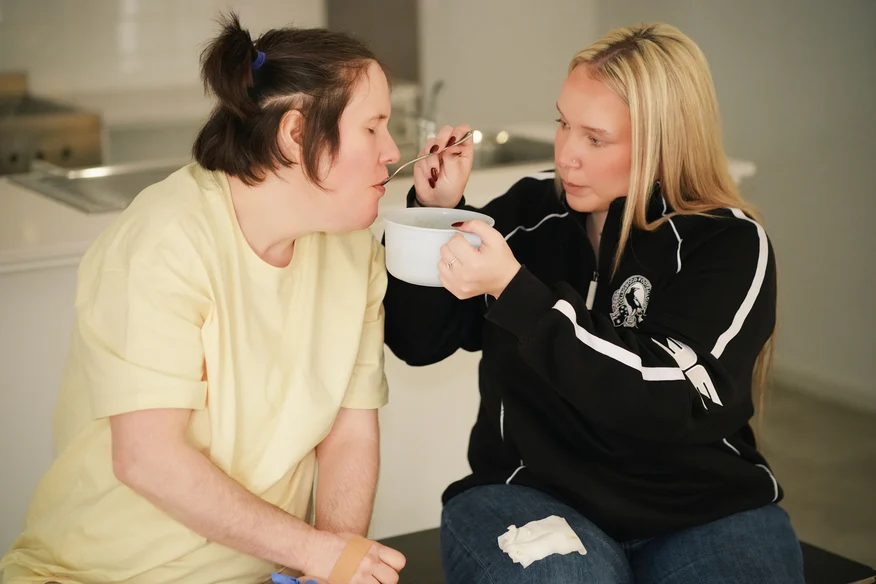
This consistency continues each day, no matter what support you have in your plan. Whether it’s personal care in the morning, help around the house or in the community during the day, or reminders and routines in the evening, it all feels like one connected service instead of separate pieces.

Why Melbourne Participants Choose Our Disability Support Services
Here’s how we deliver NDIS support every day, not just what we promise.
- Registered with the NDIS Quality and Safeguards Commission (Provider Registration Number 4050126032)
- Every worker holds a current NDIS Worker Screening clearance and police check
- Consistent worker matching, not a rotating pool of casual staff
- A dedicated coordinator who knows your situation, not a general call centre
- Quick response and fast intake, so support can start without a long wait
- Multilingual team, including English, Italian, Turkish, Filipino, Portuguese, and Macedonian
If these things are important to you and your current support isn’t meeting your needs, contact us, and we’ll talk it through together.
Disability Support Services Across Melbourne
Many participants say their biggest frustration isn’t the quality of support, but the lack of consistency. If a worker has to travel far, they might be late, cancel, or be replaced by someone new. This makes it hard to settle into a routine, especially for people who find staff changes unsettling.
We support people all over Melbourne, from inner suburbs like South Melbourne to areas like Dandenong, Footscray, Preston, and Werribee. We usually match you with a local worker, making it easier to keep your support consistent.
Not sure if we cover your area? Contact us, and we’ll let you know.

Frequently Asked Questions (FAQs)
Does it matter if my disability support provider is registered with the NDIS?
It depends on your plan management type. If you’re NDIA-managed, you can only use a registered provider. If you’re plan-managed or self-managed, you can generally use either, though a registered provider means the business has been assessed against the NDIS Practice Standards.
What's the difference between a disability support worker and a personal care worker?
The terms overlap. Personal care worker usually refers to help with showering, dressing, and hygiene, while disability support worker is a broader term covering personal care, household tasks, community participation, and more, depending on what’s in your plan.
Can I switch disability support providers if I'm not happy?
Yes. You can change providers at any time. There’s usually a notice period in your service agreement, and a new provider can coordinate the transition to avoid gaps in support.
What disability support services can NDIS funding cover?
This depends on your plan and goals rather than a fixed list. Commonly funded supports include personal care, household tasks, community participation, transport, and supported independent living, along with more specialised support like development of life skills or behaviour support where relevant. What’s actually funded comes down to how a support relates to your disability and your plan, not a diagnosis.
How much do disability support services cost?
There’s no single set fee. Rates depend on the type of support, the time of day, and whether it’s one-to-one or group-based, all set within the NDIS Pricing Arrangements. Whether you pay upfront depends on your plan management type: NDIA-managed and plan-managed participants generally don’t pay directly, while self-managed participants pay the provider and claim the cost back. Your plan manager or the NDIA can confirm the exact rate for a specific support.
Can I choose my disability support worker?
You can share preferences around gender, language, personality, or communication style, and we’ll match you accordingly where possible. If a worker isn’t the right fit once support begins, we can look at other options rather than leaving you with someone who doesn’t work for you.
Does Hilda Care provide disability support services near me?
We support participants across Melbourne, including inner and outer suburbs. Get in touch with your suburb and we’ll confirm whether we cover your area and what’s available locally.
 Posted on Google
 Omar Soliman
Trustindex verifies that the original source of the review is Google.
Really happy with the support I’m getting. Everyone is friendly, easy to talk to, and actually listens. I feel supported and comfortable. Would definitely recommend.Posted on Google WarrenI have found the services to be unbelievably great in my situation. I recommend the services to everyone who wants to be taken care of in Melbourne.Posted on Google
 Amira MoussaI’m so grateful for the care and support I receive from Hilda Care. I’ve always felt respected, valued, and genuinely listened to. The team is kind, patient, and supportive, and communication is always clear! I honestly feel lucky to be part of a service that truly cares about their clients. Thank you!!!Posted on Google
 Omar Moussa (omzy96)Lovely NDIS provider providing support throughout all of Melbourne. I have personally recieved support through Hilda Care for the past 6 months roughly. Their administration is top notch. They have gone above and beyond providing personalised support workers for my needs, have promptly resolved any issues I may have and they always try their best to deliver extra services that may help me with my needs and support. Thank you Hilda Care, you've made my transition into the NDIS as seamless as possible, and I really look forward for the years ahead 😊Posted on Google
 Grahm WatsonThanks for looking after me in SIL house in Burnside Heights. Management is excellent. Happy is looking after me very well. ThanksPosted on Google
 Kim Fleming
Trustindex verifies that the original source of the review is Google.
My experience dealing with this organisation has been very disappointing. They seem unorganised, unprofessional arrogant and downright disrespectful of peoples time.Posted on Google Divyanshu SethiHilda Care is outstanding. As a Support Coordinator, I’ve had situations where I needed a Support Worker at the very last minute for my cleints, and they delivered without hesitation. Not once or twice but always. They found the right person within hours and made sure the client felt safe and supported. They have paid heed to client’s feedback and tweaked their services accordingly everytime. Their staff are well trained, reliable, and always go above and beyond to meet client needs. It’s clear they genuinely put clients first. Highly recommended.Posted on Google
 Tommy NjegacThank you Hilda care for providing me services in caroline springs. Harry is amazing support worker. He really understands me well and my needs. God bless your company.Posted on Google
 Yasemin YakupThis is one of the most reliable and compassionate disability service providers we’ve worked with. Their communication is clear. The support workers show great understanding and patience, especially during challenging moments. They make everyday routines more enjoyable and less stressful for everyone involved. We feel very lucky to have them on our side.Verified by TrustindexTrustindex verified badge is the Universal Symbol of Trust. Only the greatest companies can get the verified badge who has a review score above 4.5, based on customer reviews over the past 12 months. Read more
Need Disability Support Services in Melbourne? Get in Touch With Us
Whether you’re arranging support for the first time or reviewing your current plan, let us know your situation. We’ll talk you through what’s possible and help you decide if we’re the right fit.
In the east, our disability support services Box Hill team runs skill-building and social programs.