

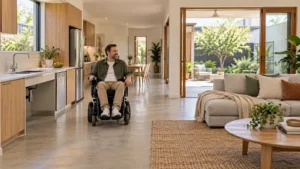
An accessible home can make everyday life safer and give someone more independence. But needing accessible housing does not automatically mean a person qualifies for Specialist Disability Accommodation, or SDA.
SDA is designed for NDIS participants with extreme functional impairment or very high support needs who meet additional housing and funding requirements. The NDIA considers how a person’s disability affects daily life, which housing features they need, and whether SDA is an appropriate option.
This guide explains the eligibility criteria, the four design categories and the evidence that can help the NDIA assess a request.
The Main SDA Eligibility Requirements
To receive SDA funding, a participant must have extreme functional impairment or very high support needs, meet the SDA needs requirement and satisfy the applicable NDIS funding criteria.
The assessment considers more than whether the current home is difficult to use. The NDIA looks at how specialist housing would support the participant’s independence and allow other supports to be delivered effectively and safely.
It also considers alternatives, such as accessible mainstream housing, home modifications and different support arrangements.
A diagnosis alone is not enough. Two people with the same condition may have different functional abilities, support needs and housing requirements.
Extreme Functional Impairment and Very High Support Needs
Extreme functional impairment involves very significant limitations in areas such as mobility, self-care or self-management. The NDIA considers the assistance a participant needs, including whether those limitations remain significant when appropriate equipment, technology or modifications are used.
Examples of relevant difficulties may include:
- Moving around the home or transferring between a bed and wheelchair
- Showering, dressing, eating or using the toilet
- Managing daily routines and staying safe
- Completing essential activities without substantial assistance
Very high support needs involve a substantial need for person-to-person assistance. The assessment considers the intensity of that support, the participant’s circumstances and how specialist housing could help sustain the arrangement.
A narrow doorway or inaccessible bathroom may be important evidence, but it does not establish SDA eligibility on its own. The request needs to explain why specialist housing is appropriate for the person’s overall needs.
The Four SDA Design Categories
SDA design categories describe the features a home needs to support a participant. They are not simply different levels of accommodation quality.
Improved Liveability
Improved Liveability homes provide better physical access and features that support people with sensory, intellectual, or cognitive impairments.
Features may include clearer visual contrasts, layouts that are easier to understand and design choices that make everyday activities more manageable.
Fully Accessible
Fully Accessible homes provide a high level of physical access for people with significant mobility needs.
Features may include wheelchair-accessible bathrooms and kitchens, wider doorways and sufficient space to move through the home.
Robust
Robust homes use durable materials and design features intended to improve safety and reduce damage and maintenance.
This category may suit some participants with complex behaviours of concern. It does not mean the home should feel institutional or that restrictive practices are automatically permitted.
High Physical Support
High Physical Support homes combine extensive physical accessibility with features for people who need very high levels of support.
Depending on the dwelling, these may include structural provisions for ceiling hoists, backup power and home automation or communication technology.
The NDIA determines the funded category from the participant’s assessed needs. A home having attractive features does not mean it matches the participant’s approved funding.
SDA Funding and Daily Support Are Separate
SDA funding contributes to the specialist dwelling. It does not pay for support workers, personal care or all the equipment someone may need inside the home.
Daily assistance may be funded separately through Supported Independent Living or another suitable support arrangement.
Not everyone living in SDA uses SIL, and approval for SDA does not automatically include approval for SIL.
Understanding the difference between SDA and SIL helps families plan for both the home and the assistance needed within it. These decisions should work together, but each support must meet its own funding requirements.
Evidence That Explains the Housing Need
An occupational therapist’s assessment can be an important part of an SDA request. Other relevant evidence may come from treating professionals, support providers and the participant’s own account of daily life.
Useful evidence explains:
- The participant’s functional abilities and support needs
- Difficulties and risks in their current home
- The equipment and assistance they use
- Housing alternatives that have been considered
- Why those alternatives may not adequately meet their needs
- Which specialist features are required and why
- How SDA would work with other funded and informal supports
For example, “the bathroom is unsuitable” gives limited information. A stronger assessment explains whether a wheelchair can enter, whether transfers can be completed safely, and whether modifications could resolve the problem.
A detailed report does not guarantee approval. Its purpose is to give the NDIA clear evidence for an individual decision.
Requesting SDA Through the NDIS
Start by discussing home and living needs with your NDIA contact or support coordinator, if you have one.
The process generally involves:
- Explaining the current housing situation and disability-related needs.
- Gathering relevant assessments and supporting information.
- Submitting a request through the appropriate planning or plan-change process.
- Responding to any requests for further evidence.
- Receiving the NDIA’s decision about eligibility and funding.
If SDA is approved, the plan identifies the funded housing arrangement, including the design category and building type.
Finding a suitable home is a separate step. Approval does not guarantee that a matching property will be immediately available in the participant’s preferred suburb.
Rent Contributions and Everyday Costs
Participants generally pay a reasonable rent contribution directly to their SDA provider. The agreed amount should be included in the written service agreement and must not exceed the applicable maximum reasonable rent contribution.
The maximum is calculated under the SDA pricing arrangements using pension and rent assistance rates. It can change when those rates are updated, so ask the provider for a current written breakdown.
SDA funding also does not cover all ordinary living expenses. Participants should budget for costs such as groceries, utilities, and other personal expenses.
Before signing, check what is included, how shared bills are divided and whether any separate charges apply.
Application Timing and Housing Availability
There is no reliable single timeline that applies to every SDA request. Timeframes depend on the planning process, the evidence available and whether further information is needed.
The time taken to obtain a funding decision is also different from the time needed to find a suitable home.
Starting early allows more time to complete assessments, consider alternatives and discuss preferences. If the current arrangement becomes unsafe or a participant’s needs change significantly, tell the NDIA promptly and explain the risks.
Avoid relying on a promised approval date or move-in timeframe before funding and a suitable property have been confirmed.
Choosing a Home That Matches the Person
An approved design category is only part of finding the right home. Location, privacy, household compatibility and access to everyday activities also matter.
When considering a property, check:
- Whether it is enrolled as SDA
- Whether it matches the participant’s approved funding
- Which accessibility features are present
- Whether daily support can be delivered safely
- The tenancy terms and rent contribution
- Who else lives there, where applicable
- How the participant can exercise choice over support providers
A vacancy is not enough on its own. The home and support arrangement need to suit the participant’s life.
SDA Guidance and Support With Hilda Care
At Hilda Care, we help participants and families discuss housing options and how daily support could work in a suitable home.
Our team can explain available options and work alongside your support coordinator and allied health professionals. SDA eligibility and funding decisions remain with the NDIA.
If you are considering SDA, contact Hilda Care to discuss your support needs, preferred location and next steps.